The
Future Of Internet
Access
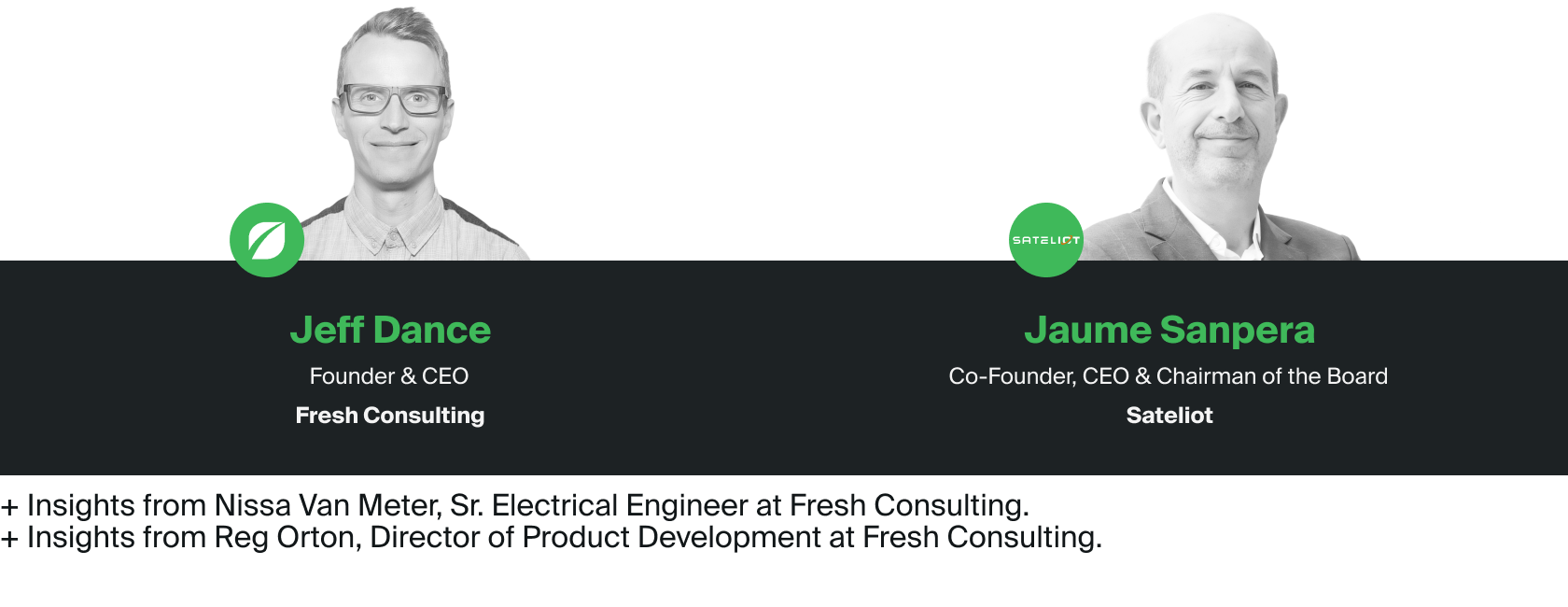
Jaume Sanpera, Co-Founder and CEO of Sateliot, joins Jeff Dance to explore the future of internet access. They discuss the barriers to keeping developing countries from having internet access, how satellite communication can increase the diversity of internet users among people and businesses, and the role of AI and machine learning in interpreting large amounts of IoT data. Additionally, Nissa Van Meter, Senior Electrical Engineer at Fresh Consulting, shares her insights on the topic.






Jaume Sanpera, Co-Founder and CEO of Sateliot, joins Jeff Dance to explore the future of internet access. They discuss the barriers to keeping developing countries from having internet access, how satellite communication can increase the diversity of internet users among people and businesses, and the role of AI and machine learning in interpreting large amounts of IoT data. Additionally, Nissa Van Meter, Senior Electrical Engineer at Fresh Consulting, shares her insights on the topic.

In this episode of The Future Of, Jaume Sanpera, Co-Founder and CEO of Sateliot, joins Jeff Dance to explore the future of internet access. They discuss the barriers to keeping developing countries from having internet access, how satellite communication can increase the diversity of internet users among people and businesses, and the role of AI and machine learning in interpreting large amounts of IoT data. Additionally, Nissa Van Meter, Senior Electrical Engineer at Fresh Consulting, shares her insights on the topic.
Sateliot is at the forefront of revolutionizing terrestrial and satellite communication sectors. A remarkable milestone was achieved when they successfully launched the world’s first commercial 5G-based nanosatellite into space aboard the SpaceX Falcon 9 rocket in mid-April of this year. This groundbreaking achievement paves the way for connecting commercial Internet of Things (IoT) devices directly from space.
Jaume is an industry veteran with an impressive three decades of experience in the telecommunications field. He not only serves as the Founder of Eurona, the top telecommunications satellite operator in Europe, but also boasts a track record as a serial entrepreneur, primarily focusing on digital environmental management and telecommunication companies.
Fifteen percent of the world’s population has access to mobile connectivity. Within this group, individuals possess the capability and opportunity to connect various devices, including trackers, at an affordable price. For instance, in urban areas, one can obtain a tracker for only five dollars upfront and a monthly fee of one dollar. On the other hand, the remaining 85% relies solely on satellite coverage. Unfortunately, satellite devices have traditionally been perceived as expensive due to the nature of their name.
This discrepancy between mobile and satellite connectivity becomes apparent when considering the number of connected devices. In the fifteen percent of the world with mobile connectivity, there are already five billion connected devices. In contrast, the other 85% accounts for a mere five million connected devices.
However, there is a need to bridge this gap and bring about a revolution similar to what has occurred in urban areas worldwide. Upon examining standard devices, it becomes evident that they rely on a direct connection to satellites positioned at altitudes ranging from 500 to 700 kilometers rather than the geostationary satellites situated thirty thousand kilometers away.
To facilitate this transition, Sateliot possesses significant expertise in the 3GPP. Over the past few years, the company has actively contributed to the development of these standards. Finally, in June 2022, the new revision of the standard was approved. This means that the same device that functions for fifteen percent of the world with mobile connectivity will now also work for the remaining 85%.
Although five billion people worldwide have internet access, there are still individuals who lack internet connectivity. Starlink offers high-quality internet access no matter where you are, comparable to fiber connectivity. However, the cost of this service amounts to five hundred dollars. While some individuals may be able to afford it, the majority cannot. The only solution to reduce the device cost is through standardization.
Only around eight to ten million customers currently utilize satellite internet access, which is a meager number when compared to the global population in the billions. The concept of connecting everyday devices to satellites has the potential to significantly expand overall access.
By enabling broadband connectivity directly to mobile phones, we would require large satellites equipped with extensive towers in space. Sateliot’s vision is to ensure that satellite-enabled broadband connectivity to mobile phones becomes operational in developing countries.
The impact of increased access to global two-way communication through IoT devices has far-reaching effects on users and businesses. In various sectors of the economy, the potential for IoT is immense. For example, in the logistics industry, which accounts for thirteen percent of the world’s GDP, we have witnessed significant global supply chain challenges in recent years. However, by expanding IoT coverage and utilizing IoT devices instead of relying solely on periodic satellite communication, we can gain a deeper understanding of the supply chain and resolve issues more efficiently.
Agriculture is another sector benefiting from IoT advancements. Farmers who have already adopted sensor-enabled devices have experienced a forty percent reduction in water usage. These examples showcase how major macro industries can be transformed by IoT.
To draw an analogy, consider the concept of preventative medicine in healthcare. By monitoring health indicators proactively, we can detect and address issues before they become severe, minimizing the need for extensive treatments. Similarly, with enhanced connectivity and intelligence provided by IoT, we can prevent wastage and improve outcomes across various domains in real time.
The ongoing conflict between Russia and Ukraine has provided a fascinating insight into the profound impact that war can have on a country’s connectivity. It is remarkable to witness an entire nation facing the risk of losing essential communication networks. However, the introduction of satellite providers has swiftly addressed this issue, with the establishment of thousands of Starlink terminals in Ukraine offering reliable internet access. The digitization of warfare is an inevitable development, as it paves the way for highly affordable connectivity solutions.
In the near future, we can expect each mobile phone to be accompanied by approximately twenty IoT devices, further enhancing connectivity and interactivity. The satellite industry is experiencing rapid advancements, with ambitious plans underway for establishing a permanent lunar base. This remarkable progress demonstrates the potential of space-based technologies to revolutionize various aspects of our lives.
When embarking on new disruptive ventures like the one we are currently witnessing, it is crucial to consider both economic sustainability and profitability. However, it is equally important for us to be conscious of the challenges our planet faces and actively contribute to finding solutions. As entrepreneurs and innovators, we must embrace our role in addressing these challenges while building successful and profitable businesses.
AI and massive IoT activity are mutually dependent as they complement each other’s functionalities. The presence of sensors is essential in capturing real-time data, enabling us to understand the events taking place. However, without the power of AI, it becomes challenging to derive meaningful insights from the vast array of data collected by tens of thousands of sensors deployed in the field. By leveraging AI and machine learning, we can enhance the usability of this data, enabling us to discern patterns, draw conclusions, and extract valuable knowledge from sensor-generated information. Ultimately, AI empowers us to make informed decisions and leverage the full potential of massive IoT activity.